← All articles

The Stag Hunt

We hunted the stag. The stakeholders took the hare.

We pitched one big platform, backed by data and the people who would use it every day. The stakeholders chose a small fix. A 270-year-old game explains why.

In 2024 I worked on a project to reimagine a client's customer service support platforms. Their customer service representatives, the CSRs, did their jobs across several disconnected software platforms. Our pitch was to replace them with one feature-rich platform built around how the CSRs actually work.

We did not get it. We got small changes to one key feature. This is the story of why, told through a game the philosopher Jean-Jacques Rousseau described in 1755.

The game

Two hunters head into the forest. Each one can hunt a stag or a hare.

The stag is the big prize, but it takes two people to bring it down. The hare is small, but you can catch it alone. If you go after the stag and your partner peels off to chase a hare, you go home with nothing.

Nobody in this game is a villain. Both hunters want the stag. The question is whether you trust the other one to stay.

The scoreboard
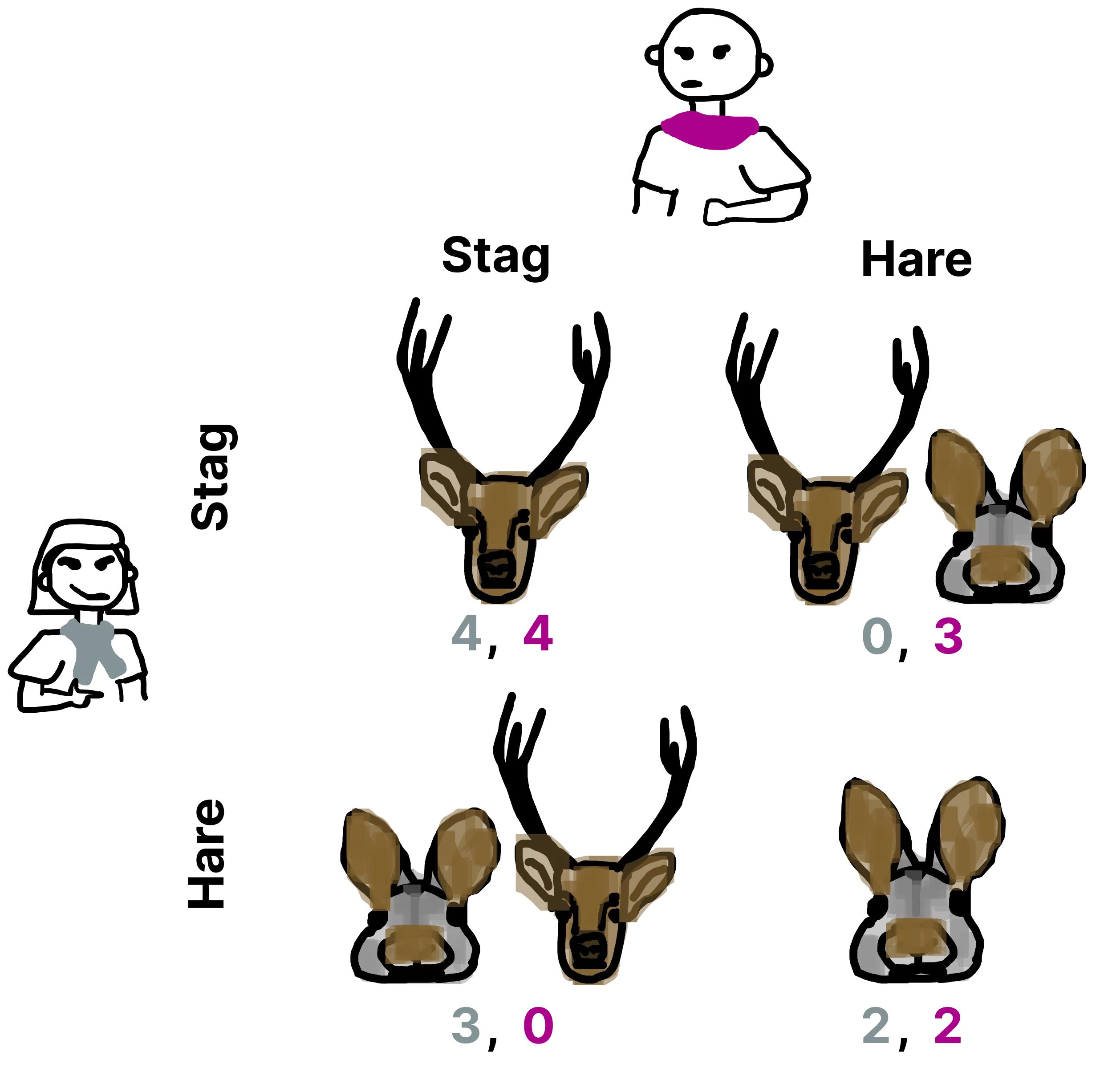
The Stag Hunt scoreboard. Purple's choice across the top, Gray's down the side. Both hunt the stag: 4 and 4. Purple hunts the hare while Gray hunts the stag: Purple 3, Gray 0. Purple hunts the stag while Gray hunts the hare: Purple 0, Gray 3. Both hunt hares: 2 and 2.
Gray's points first, then Purple's. Points are meals: a stag feeds both families for days, and two people chasing hares end up chasing the same ones. We landed bottom right.

Two outcomes are stable. If both hunt the stag, neither wants to leave. If both chase hares, neither wants to switch to the stag alone. Like the Prisoners Dilemma, each is a Nash Equilibrium: a place where nobody does better by changing their move alone.

The stag is the better equilibrium. The hare is the safer one. Which one people land on depends on trust.

The players

Purple was my team and the CSRs. Gray was the client's main group of stakeholders.

The stag was one platform that brought the support tools together. The hare was small changes to one of the key features in the tools they already had.

We were not sure what the client would commit to. That is the Stag Hunt in a sentence.

Our case for the stag

We led with user data. We had metrics, and we had buy-in from the CSR teams who would use the new platform. They believed it would improve their own numbers and KPIs, and they said so in writing: quotes and emails telling us it fit their needs.

For a design team, that is about as strong a case as you can bring into a room.

Gray took the hare

The stakeholders defected. The stag escaped to munch leaves another day, and we barely caught a hare. Gray got their hare too, but missed the stag.

Their reasons were cost and shifting priorities. A new platform meant a large budget and a long timeline, and by the time it came to commit, other things were competing for both. Small changes to one feature were a hare they could catch now.

That is the part of the game you cannot see from your side of the forest. You never know for sure what else the other hunter is weighing.

Run your own hunt

Where the lines cross

The stag's value climbs as Purple gets surer that Gray will stay. The hare barely moves. Where the lines cross is the tipping point.

Points per season, on average. Hunt the stag: stag size × how sure Purple is. Take the hare: 3 if Gray hunts the stag, 2 if Gray chases hares too.

What the data could not do

Try it above. A bigger stag pulls the crossing point to the left: the more the stag is worth, the less sure you need to be of your partner. Our data made the stag bigger. It did not make Gray any surer that the hunt would hold together, and below that line even a huge stag loses to a hare.

There was a second problem. The CSRs were on our side of the hunt. They were the real beneficiaries, but they had little say in the decision. Their quotes made our case stronger, but they were not the ones who had to commit budget. Praise from the people who use a product does not change the scoreboard for the people who pay for it.

Data shows how big the stag is. It does not show that your partner will stay.

Speaking PM: how to hunt a stag with stakeholders

Product managers and executives think in risk, sequence and return. If you are a senior or staff designer pitching the big version, speak to all three.

  1. Price the downside, not only the prize. Our data told the stakeholders how good the stag would be. It did not tell them what happens if the hunt falls apart halfway. Answer that before they ask: if we stop after phase one, what do we still have?
  2. Turn the stag into a trail of hares. Break the big version into phases that are each worth shipping on their own. Then the safe choice and the bold choice point the same way, and every hare moves you closer to the stag. In PM terms, that is a phased roadmap where every phase has its own return.
  3. Use their scoreboard, not yours. CSR metrics are your users' KPIs. Find the numbers the stakeholders are measured on, such as cost per contact, staffing or a target on their quarterly review, and show how the stag moves them.
  4. Ask for a small commitment early. As the Ultimatum Game experiment showed, a yes is cheap talk until it costs something. A funded discovery phase, a named owner or a decision date tells you whether Gray is really on the hunt before you put your whole team on the stag.

We caught a hare. The stag is still out there.

Your turn

Your stakeholders will not commit to the big version. What do you do?

Have you ever been Gray? What made the hare look safer?